Demons
The entire Hierarchy is made up of 20 ranks, in theory. The top rank is supposed to be the Demon God, the Elemental Spirit of Evil, who does not yet exist because nobody has died while holding the Evil Core yet. So in practice, there are only 19 ranks. Demons have 1 ‘boss’ and 3 ‘underlings’ (except for the highest and lowest ranks, of course).
For you math nerds itching to do the math of how many demons there are, I’ll do it for you: 1,743,392,200, in theory. In practice, it’s always at least one less because there is no Demon God. Plus there are often spots open in the bottom.
In reality? The population of the Makai is closer to about 5 billion. There are pros and cons to joining the Hierarchy. Not every demon is given a choice, but when they do have the choice? Sometimes it’s better to stay out.
Pros of joining the Hierarchy: guaranteed housing, job, food, community. Well, kinda… in some realms, the Demon Lord doesn’t bother trying to rule their people, so anarchy reins and whether you get food or not is dependent upon how orderly the realm was during harvesting season, or whether you dare to raid a neighboring realm. Joining the Hierarchy is also the only real way to be elevated in society, politically or martially. The ruling class and military superiors are all in the highest ranks.
Cons of joining the Hierarchy: being murdered, being obliged to obey your superiors, and being bound to obey the Compulsion.
Being murdered is the big one, there. See, there are two ways a demon can climb the ranks of the Hierarchy: either you convince your superior to trade places with you, or you kill them. Killing your superior to take their position is legal. Hell, killing your subordinate because you think they want to kill you is legal.
Demons in the Hierarchy instinctively know who their superior and underlings are. They also know when there’s been a change. This is how the demons know certain nobles are alive (such as Hira and Zuriko) even though they haven’t been seen in centuries.
There are a few spots where trading places is not allowed and you *must* kill to rank up. The 20 ranks are divided into two groups of 10, called the upper echelon and lower echelon. Getting into the upper echelon requires killing the one above you to ensure only those with a willingness and ability to kill are in the highest ranks. Even in instances where the higher-ranked demon was killed through other means, there will often be a forced three-way duel between the underlings to decide who gets to ascend the rank. Once in the upper echelon, you cannot go back down. This is repeated at the rank to become a Lord, though in this instance it’s because Lords are granted certain rituals and magical abilities which can never be revoked.
When a demon achieves the rank of Lord, they have a week to report to Ayuthiel and describe what they want their ritual and attribute to be. If they refuse to do this, they will suffer unbearable agony and may die, leaving the spot open for someone else to take.
Their ritual can be anything. Literally anything. It can be possible or impossible. It can have restrictions like ‘only a child can perform it.’ It can even be left up to the Lord to select who may summon them. For instance, Midnight Cake can only be summoned by people she has kissed.
The attribute can be anything which Ayuthiel perceives to be ‘evil’ ‘negative’ or ‘troublesome’ in some manner. Ayuthiel is an open-minded man and is willing to hear arguments about why certain attributes should be ‘evil.’ He did not initially consider ignorance to be evil, and had to be convinced by Williford. Ayuthiel also only needs to be convinced long enough to set up the ritual. If he changes his mind later, it doesn’t invalidate the Demon Lord’s attribute. For instance, Ayuthiel has been known to flip-flop on whether he considers insanity to be ‘bad’, as he knows it can lead to people doing bad things, but that it’s also a symptom of mental illness and not all ‘insane’ people are bad. When Leminestra was applying for the attribute of Lord Insanity, she had to argue her point to Ayuthiel while Williford argued that insanity was not evil and should not be allowed as an attribute. To be fair, Williford was making the argument for reasons of his own: the previous Lord Insanity had been his friend, Emberdyme, who had died years ago. Williford did not want there to ever be a new Lord Insanity, as that had been his friend’s title. In the end, Ayuthiel was persuaded by Leminestra, largely because he felt that Williford was only making the argument in defense of Emberdyme. In recent years, Ayuthiel has gone back to thinking that he should not have granted it to her.
The attributes also have to be sufficiently different from another, which is yet another thing a Demon Lord may need to convince Ayuthiel about. A number of Lords have wanted to take the attribute of ‘Nightmares’, but Ayuthiel considers that to be part of Terror, Vinoc’s attribute.
Lastly, it should be noted that once you reach the rank of Lord, you cannot harm any other noble except for the Prince one step above you. Princes can only attack their King and three Lords. Kings can only attack their three Princes. There are magical effects in place to ensure no Lord can hurt another Lord. As a side-effect, all Lords can walk on the ocean, because entering Deep Sea without him knowing is considered ‘an attack.’ However, if Deep Sea allows them in, they can also breathe underwater because Deep Sea trying to drown them would also be considered ‘an attack.’ It has also been demonstrated that a Demon Lord thrown at Deep Sea with enough force to kill them will have their fall magically cushioned.
Details of how demons are created here.
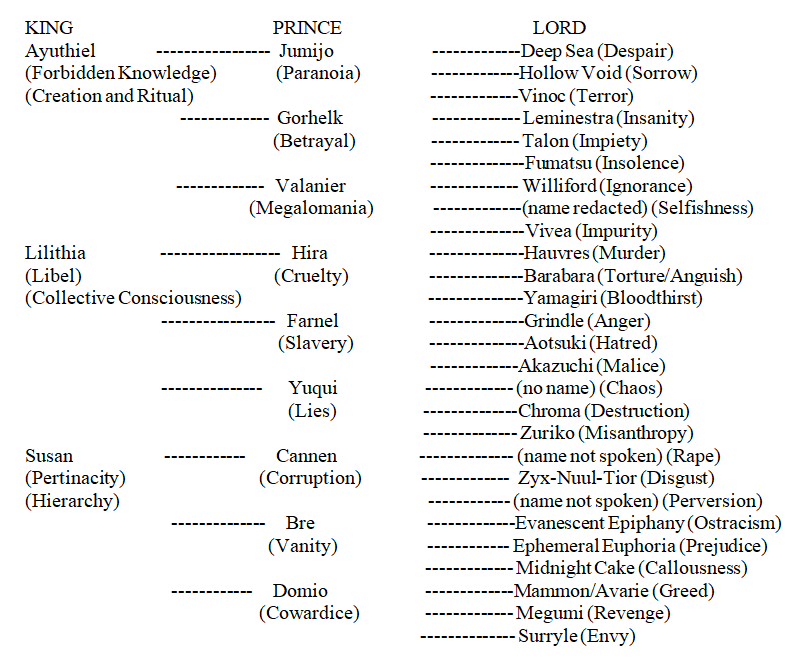
The Demon Nobles at the start of the year 561 AS.
-
Appearance: Massive, at least 100 feet tall. Humanoid-shaped, with the head of an elephant. Has a growth on his back and shoulders which will become a new crucible. He only plucks off a new one when the old one is destroyed. Usually seen sitting cross-legged in his home, the Palace of the Kings, with the crucible between his knees. Ayuthiel is a man and has a man’s memories, but his elephant-trunk features “female” reproductive organs and the crucible on his back can serve as a “womb” that bears children.
Abilities: As one of the original six demons to be created at the Mirth Massacre, he has an additional power that gets inherited to anyone who can kill him: Ritual-making. Ayuthiel and his successors will have the power to grant ‘rituals’ to other demons. Ayuthiel granted the Ritual of Creation to himself, which will also be inherited by his successors. Ritual-making is a complex Evil elemental ability that weaves aspects of the other elements and must be performed carefully. It’s also a “softer” type of magic. It requires creativity and willpower, and doesn’t always follow the sort of “hard magic” rules the other elements follow. Ayuthiel has mastered it due to his immense level of patience, but he’s warned the other demons that future Demon Kings might not be successful. A more impatient King might end up killing himself, and then the power of creation and ritual-making could be lost forever. The Princes and Lords beneath Ayuthiel have no desire to kill him because they do not want this responsibility. One of the rituals allows Ayuthiel to bestow a sphere of influence and a summoning ritual upon new Demon Lords. The summoning ritual can be anything the Lord wishes, but the sphere of influence has to be something Ayuthiel considers ‘evil.’
Personality/History: Ayuthiel was created during the Mirth Massacre, the event that created the first six demons. He was made from the corpses of slaughtered Quithians. When he was first born, he only had memories of one man, an alchemist/apothecary, which became his identity. He is aware of many other Quithians inside him, including his wife who died while pregnant, but his memories of the others feel distant and impersonal. He retains the personality of the Quithian alchemist: a devoted father and husband, a dedicated worker, a creative who enjoyed making new potions and herbal remedies, and a patient man who is content to live out his life until the world ends. After his demonification, Ayuthiel had two daughters, both through King Lilithia: Hira (Prince Cruelty) and Yuqui (Prince Lies). Hira was first, and he doted on her immensely. His entire life revolved around Hira between her birth and disappearance. Ever since she vanished, Ayuthiel has been despondent, depressed, and cares little for his work. He had a change in philosophy as well, and now certain spheres are difficult for Lords to choose, since Ayuthiel can no longer be convinced they are ‘evil.’ During the Conquering, Ayuthiel only wanted to do what was best for Hira, so he instructed her to surrender to Lucognidus right away. They were both spared his wrath.
-
Appearance: A black cloud that circles the Makai several times, like a trail of smoke. He doesn’t live in any specific city since he occupies the skies of the Makai at all times. He can create eyes within the smoke (as many/as big as he wants). These eyes are yellow, with black spirals inside them. He can break off pieces of himself to see things at the surface level. He can also go through portal to visit the other planes. Those smoky ‘pieces’ can be killed, but wouldn’t even cause pain to Jumijo. At most, he would find it inconvenient. The smaller pieces are repelled by Godlights, but a larger piece is not.
Abilities: One of the original six demons to be created during the Mirth Massacre. He has a power which will be inherited by anyone who kills him: Mind Domination. He can inspire people to worship him, make sacrifices to him, and fear him. He can also shoot heat-based lasers out of his eyes which can start fires.
Personality/History: Jumijo was created during the Mirth Massacre. As some corpses were being burned, the blood of the Pixie of Evil merged with the smoke, and that smoke became Jumijo. He had no prior memories, but slowly developed a personality enjoying evil acts. Like Deep Sea and Hollow Void, he did not become aware of his own existence immediately, and the original Three Kings didn’t realize he existed when they designed the Hierarchy. When Jumijo learned to control his Mind Domination powers, he used it to make the Munil planet his toy. Mujin, Nilians, Camazotz, Ingles, and the species of the Life Tree were all devoted to worshipping him. He would consume the souls of those who were sacrificed to them, and eventually had so many disparate memories that he lost his sense of self. During the Conquering, he fought against Lucognidus and lost. Lulu broke Jumijo’s mind, which was already starting to fracture, and ruined the way his power once worked. In the current era, Jumijo is prone to rambling incoherently, wandering through the Makai aimlessly, and only occasionally sends pieces of himself down to the surface… and those pieces tend to just wander about. He can still communicate with people who summon him, and he acquires some mental clarity when this happens, though he’ll lose himself again when the summoning is over.
-
Appearance: He is the ocean of Aloutia, the Makai, Cosmo’s Blue Home, and an underground body of water in Ophidia. He can possess an animal or person if they’re touching his body. Portions of his body might detach from him, such as when it goes through a portal in which he doesn’t have power on the other side. However, water that enters him such as from rain or rivers will become part of him again.
Abilities: Being the ocean, he has various aquatic-related powers. He can move things with him, create air bubbles, change the atomic structure of liquids within him, accumulate particles into solid masses (such as gathering up salt and depositing it as a huge salt block), and manipulate pressure. He can create oceanic pocket dimensions, though they are entirely oceanic and lack light except from bioluminescent fish and flora. He can possess any living entity within him, a power he uses mostly to make fish in the abyss find sources of food. As one of the original six demons, he has a power that will be inherited by anyone who can kill him, in this case it’s the power of ‘Pressure.’
Personality/History: He is both a cruel Demon Lord who demands worship, and a loving, caring protector of his ‘pets.’ He was created during the Mirth Massacre. When the Pixie of Evil’s blood dripped into the ocean, those blood droplets created him. However, Deep Sea did not become aware of his own existence for about a month after, long enough for Coelacanth to create the Hierarchy without him as one of the Kings. Many of Deep Sea’s worshippers believe the Hierarchy should have been created with each of the six original demons as a King. While Deep Sea does feel he was slighted, he’s not too upset because while he has fewer demon minions than the Kings, he has power over all aquatic mortals. He will grant favors to those who serve and worship him, and hurt those who refuse. The merchants of salt are people who buy salt from him in exchange for biological material (plants and animal carcasses mostly). He uses the biological material to feed his pets (fish, particularly those in the deepest parts of his body). Deep Sea is fond of his fish and plays with them in almost childlike ways. During the Conquering, he and Lulu were of equal power, and could not kill each other.
-
Appearance: He is outer space (called the Hollow Void by the people of my world). He exists in all planes simultaneously. He can ‘be’ every part of outer space, or just small pieces at a time. Spiders were originally his minions, created by him, though they became their own animals and can now live without his interference. Hollow Void can possess spiders at will, and he uses them as his avatar when he wishes to communicate with mortals.
Abilities: As one of the six original demons, he was born with a power that will be inherited by anyone who can kill him. In this case, it’s his ability to control, command, and possess spiders. Beyond that, he also has ‘void’-based powers. He can create empty pocket dimensions, create and manipulate ‘spaces’ of nothingness in reality, possess/speak into the minds of other people, and destroy matter.
Personality/History: Hollow Void was created during the Mirth Massacre when the Pixie of Evil’s blood merged with the air and space above the city of Mirth. Because he did not become aware of his existence until a month had passed, he was excluded from the original Hierarchy created by Coelacanth. He cares very little for the Hierarchy in general, preferring to focus on his own self and desires. I can’t say too much about Hollow Void’s ambitions because it’s a huge part/spoiler for many of my books. What I can say if that many mortals assume he’s not an issue. They think he’s just up in outer space playing with planets and meteors and stuff. He’s actually very invested in sapientkind. During the Conquering, he allied with Lucognidus.
-
Appearance: Invisible in ‘reality’, he can only be seen through reflective surfaces like mirrors and water. He was reborn from three Pellan men, and bears the appearance of one in particular. His blond hair always covers his eyes, though he can see clearly without using his eyes. He wears a black overcoat, skull pauldrons, and skull boots with his talons jutting out of the eye sockets. He has black feathered wings, but can fly without them. He was created with a few knives and a mirror which are technically part of his body, similar to his clothes. He can exist anywhere, though many mortals incorrectly believe he can only be someplace if there’s a mirror for him to materialize in.
Abilities: He can inspire terror or bravery in others, create storms (has various powers related to making rain, thunder, lightning, hail, snow, wind), and possess people. Because he doesn’t have a fixed size, his strength is immeasurable. He can theoretically lift and move anything. He can create a pocket-dimension within his mirror (called the World of Mirrors) and trap people inside it. While inside the mirror, they will perceive time however Vinoc wishes. If he wants them to spend five minutes inside, but feel like they’ve been in there for five years, he can do so. While a person is inside the World of Mirrors, Vinoc learns what that person fears the most, and he can make them experience that fear over and over again. He can torture an endless number of people at a time, and he does not have to personally pay attention to it. His ‘mirror-selves’ can handle the minutiae of torture while he deals with ‘real-world’ matters.
Personality/History: Vinoc was created from the corpses of three Pellan men, known as “the king, the prophet, and the skinner.” Each was a troublesome person in Pellan society around the year 62 and was captured/killed by a mob of Pellas. In those days, a common execution method was to kill a person, give them to Ayuthiel to turn into a demon, and then kill them again. The skinner was a gruesome murderer/artist who had tortured people while they were alive, so his punishment was to be kept alive through the demonification process (being put inside Ayuthiel’s crucible). It was the first time Ayuthiel allowed it to happen, since he knew the process of demonification would torture and kill anyone who was alive when he shut the crucible’s lid. The terror, pain, and trauma of it caused the skinner to develop powers over terror when he was turned into a demon. The minds of the king and prophet were joined with the skinner, and the new entity had traits of all three personalities. The new demon was so powerful that the Pellas who wished to execute him could not do so. He instead tore them to shreds. He wasted no time in climbing the Demonic Hierarchy and becoming a Lord. Since he already had power over terror, he wanted that to become his sphere of influence, but it was already taken by King Bwendelyn. He killed her just so her sphere would be available.
He wanted to create a complex, but meaningful summoning ritual. His history with the girl Vinoc would take a topic all of its own, but I’ll just say he chose a girl who was being abused to be his ‘priestess.’ He possessed her, made her kill her family, and then went on a rampage until she was killed by her neighbors. The Demon Lord’s summoning ritual was then to paint that girl. For many years, he only went by “Lord Terror.” The girl’s name got conflated with him due to a translation/grammatical error in the Encyclopaedia Daemonica. What was “If you paint the Umi girl Vinoc, the Demon Lord of Terror will appear” got changed to “If you paint the Umi girl, Vinoc the Demon Lord of Terror will appear.” Some people mistakenly thought Vinoc referred to the Demon Lord rather than the girl, and would refer to Lord Terror with her name when they summoned him. At first he was just confused, but he liked the name and embraced it as his own. Around that time, the girl Vinoc was around 17 years old in the afterlife and had finished apprenticing to Lucognidus, who wished to use her as a connection to the Demon Lord. The girl-Vinoc chose the title “Demigoddess of Terror” saying “if he’s going to take my name, I’ll take his title.” Over time, the two Vinocs grew close, and eventually became lovers.
The Demon Lord Vinoc enjoys torture and humiliating others, though he’s a competent administrator and ruler, as well. He has his limits on torture. He won’t hurt children. He dislikes sexual torture, though he will employ it in certain instances. For the most part, the people of his realm are happy and successful. He’s one of the few Lords who upkeeps order, creates fair laws, and promotes justice.
-
Appearance: A big fucking dragon. Black scales, vicious horns, glowing red eyes, smoke coming out of his nostrils, the whole works.
Abilities: Can spit fire and acid out of his mouth. Sharp claws/teeth also good for killing. He has a kind of synesthesia where everything tastes the way its name is “spelled.” Obviously ‘spelling’ is a social construct, as are names, but the Evil element works by analyzing and playing with social constructs, so if this comes off as ‘weird’ to you, ask yourself why you don’t think anything else demons do is weird. A thing or person’s ‘name’ has to be accepted as its magic name by an entity with power over knowledge (Williford and Lucognidus), or be recognized as a person’s magic name by 88 sapient people. Gorhelk can sense flavors for letters in Aloutian-English and the Orochigo syllabary, though not all muji (kanji) have a flavor. The letter ‘K’ is particularly delicious and Gorhelk cannot resist anything that starts with a ‘K’ unless some aspect of it also starts with a ‘D’ which is the most disgusting letter (and why he won’t eat demons or other Dragons). In many places in the Pentagonal Dominion, you’re not allowed to give your child a name starting with a ‘K’ for this reason. The letters ‘C’, ‘Q’, and ‘X’ were invented by various cultures to get around his love for ‘K.’
Personality/History: His level of sapience is unclear to most. He just likes to eat and doesn’t talk much. When he does speak, it’s just to talk about the taste of something. He really like cucumbers (spelled ‘kyukumbers’ in the written version of English in the Pentagonal Dominion). He lives in Cucumber City with his subordinate Lord, Fumatsu, though Fumatsu is more in charge than Gorhelk. Lucognidus says Gorhelk is fully sapient, but doesn’t talk or communicate because his throat/tongue/mouthparts aren’t built for it. When he speaks, acid may drip into his trachea/lungs, which is uncomfortable for him.
-
Appearance: A beautiful, pale, queenly woman, humanoid in appearance. White skin, silver hair, silver eyes. She can change her clothes, and often wears a chainmail breastplate and a sword in a white scabbard. She wears a gauntlet over her right arm with slits along the fingers because she can extend razors out from them. Her left hand is bare.
Abilities: She can transform her left arm into various shapes, with various levels of ‘hardness’ e.g. she can turn her arm into a sword, shield, or a tentacle. Her right hand has long, sharp razors.
Personality/History: She was reborn from the corpse of a Myralese Queen (Myral is a vassal nation of Aloutia infamous for its court intrigue.) When she was mortal, the queen had summoned Vinoc so many times to kill her courtly enemies, that she had to promise her body to him after she died. Meaning her body would be put into Ayuthiel’s crucible and Vinoc would own the demon that emerged. During demonification, the queen’s body split into a dozen different copies of itself, but Vinoc only insisted on taking one of them. All twelve were very strong and capable of becoming Demon Lords, though only Leminestra has made it to that coveted position so far. The copy Vinoc took, named Leistra, is one of his servants.
-
Appearance: Humanoid shape, mechanical parts on legs, roller blades on feet, and raptor talons on his arms. Winged. Black hair cropped close to his head, widow’s peak, aquiline nose.
Abilities: Very fast both in flying and in skating on a smooth surface. Can swoop from below or invert gravity to bring someone closer to him.
Personality/History: He was reborn from the corpse of a man named Talon Danyun, a Takyufon (one of my species which have roller blades for feet). His soul in Spiritua is now one of Sawyer’s servants, the Demigod of Bureaucracy. Talon was going to be tortured to death to summon Barabara, but Laynie put him out of his misery before that could happen. Unfortunately, his body ‘remembered’ the torture the summoners performed on him afterward and when he was reborn as a demon, he thought the Gods had failed to help him. He despises the Decatheon and actively works to create heretics among mortals. He frequently acquired Ophidian slaves, frees them, and trains them to cause havoc throughout the dominion.
-
Appearance: A black-skinned Yetrian man and a white-skinned Orochijin man combined into one. Black on the right, white on the left. The head is ‘merged’ in such a way that they share a middle eye, but they have two separate noses and mouths. They can both speak independently of one another. They can change their clothes as needed, but enjoy dressing up as a businessman.
Abilities: Weak telepathy (must be close) and precognition (can only see about ten minutes into the future). Can create explosions with a snap of his fingers. The explosion can ‘happen’ anywhere within a decent range of him.
Personality/History: Since Fumatsu is the villain of Merchants of Dance and Hedonism, some of his backstory is spoilers, so I won’t divulge it here. He lives in Cucumber City with Gorhelk and manages his cucumber farms… while also really despising Ophidia and Aloutia both. He wishes for those two countries to go to war. As the Lord of Insolence, he has incited slave rebellions in Ophidia.
-
Appearance: He resembles a white-skinned human boy, around 8 years old, with short brown hair… an can transform into a giant mecha.
Abilities: In his mecha form, he has most of the standard stuff you’d expect from a mecha: guns, lasers, rocket-propelled legs, and a steel outer shell.
Personality/History: He just wants to live a nice, relaxing life with his friends in the Circle of Friends. He’s close to his subordinate Lords and will trade places with them anytime they need someone to protect them, since he’s the strongest of the four (or at least the best-defended, thus the least likely to die). Although he looks young, he’s been a demon for a very long time and is actually old and wise. He enjoys philosophic and political discussions and debate. He also likes cute animals, gardening, and cooking. He’s willing to try any hobby at least once, and finds most ‘good’ things enjoyable. He used to be more evil, but after his 500th birthday, starting to find those sorts of activities boring. He was friends with Emberdyme and used to live with him. The city is still called Kalu Alma Emberdyme, which Valanier insisting on becoming its official name regardless of who rules it.
-
Appearance: Bald humanoid white man, middle-aged, blue eyes. A ring on his left ring finger. Can change clothes, since he went naked into the crucible.
Abilities: He can hoard ‘secrets’ (things known by fewer than 88 sapient people) which he can burn as fuel to cast a variety of magic. Also has power over ‘knowledge’ and can change what people thought was ‘truth.’
Personality/History: His backstory is hinted at in Merchants of Knowledge and Magic, and will be described in greater detail in future books. His personality is basically jovial middle-aged man. Adores Vivea who he treats like a granddaughter. Friends with Lord Selfishness and Prince Valanier.
-
Appearance: Ulese woman with white skin, red eyes, brown hair and long Ulese eyebrows. Stuck in the clothes she died in, which was red leather dominatrix gear and red gossamer. Also has a khopesh which is part of her body.
Abilities: Sucks up matter into her sword, which then fuels the creation of portals. When she slashes with her sword, she can create a portal of any type of matter. In order to create a portal to another location, she must know where it is and personally go there.
Personality/History: Really hates the Demonic Hierarchy and wants to dismantle it, but knows she’s too weak to do it alone. Biding her time until she can get more allies on her side. Loves chocolate cake. Is friends with the others in the Circle of Friends, as well as with Midnight Cake. She is legally a noblewoman in Ophidia and has a castle in Ophiuchus where she keeps many portals she’s created over the years. She charges Ophidian women to use them for travel. She has been known to rescue slaves who were about to be executed or tortured for some noblewoman’s pleasure. Although she looks like a sexual entity, she doesn’t enjoy having sex. She does enjoy watching others, though.
-
Appearance: Little girl, gothloli aesthetic. Black and purple dress, striped stockings, and shoes. She has black hair, but will point out to people that it used to be silver.
Abilities: Her abilities only awaken when she’s upset. When she cries, anyone who can hear her will bleed out from their eyes. She can ensure that a projectile will hit the shooter’s intended target, which works best when the target is a living organism, though it will work on moving inanimate objects, too. She can cause other bodily horror, though only when she’s scared… and she doesn’t have control over it.
Personality/History: I can’t say too much because it’s spoilers for my world in general. Her backstory is hinted at in Merchants of Knowledge and Magic, and will be explained in other books. She was reborn from the corpse of a 7-year-old girl. The soul went to Spiritua and aged like normal, but since Vivea is a demon, she’s stuck in a 7-year-old’s body forever. Because her powers awaken (and are uncontrollable) when she’s upset, she agreed to a deal with Williford. Basically he would shelter her from the world, keep her ignorant, and she’d be able to live a good life. Vivea is aware that she’s being kept ‘ignorant’ but she’s okay with it because she just wants to live (and if her ignorance helps feed Williford, all the better).
-
Appearance: From the waist-up, she is a Medusa-like woman with penises for hair. From the waist-down, she is water, usually in a serpentine shape, giving an aesthetic of ‘a river.’
Abilities: Many water-based powers. She can create more water from her body to flood large regions. She also has weak telepathic abilities and, as the successor to Bwendelyn, is in control of the demonic Collective Consciousness, a system whereby she can send and receive messages to/from every demon in the Hierarchy if she wishes.
Personality/History: She was created from the body of the previous King in her position, King Lilith, who took the spot of Demon King when Vinoc killed Bwendelyn. Lilithia has all the knowledge, memories, and personality of Lilith, and are considered the same ‘person’ by most demons, though she did have to climb the Demonic Hierarchy anew after her death and rebirth. Lilith was killed in a duel for Kingship. Though she lost as Lilith, she climbed the Hierarchy quickly as Lilithia and defeated the one who’d killed her. As Lilith, she’d reproduced with Ayuthiel and made Hira. As Lilithia, she had Yuqui with him. Although Lilith/Lilithia has a woman’s body and considers herself a woman, she ‘impregnated’ Ayuthiel with a penis from her hair. Lilith was a supporter of the Ophidian Revolution and was a major component into its success. When she became Lilithia and acquired power over water, she sought to become friends with Liqua, since she didn’t want the Water Goddess being jealous of her like she has always been toward Deep Sea. Liqua and Lilithia have a complex relationship, but it’s not one of animosity.
-
Appearance: She’s a young adult/teenage-looking girl in a double-breasted red coat and white scarf. She has white skin, dark brown hair, and bright magenta eyes. One arm ends in a long, thin blade, whereas the other ends in shears. The ends of her white scarf can grow and change shape, to a degree, including forming hands. She can also stand on her own scarf’s hands and float.
Abilities: She can enchant almost any other magic into her hands as needed, giving her access to almost all magic. The parts of her body that look like clothes are indeed just ‘clothes’ and she cannot be hurt by being cut, for instance, on her torso. She recovers at a phenomenal pace. She is considered the most powerful demon after the Trifecta.
Personality/History: She is a second-generation demon, having been born from the mating of Ayuthiel and Lilithia (as Lilith). Ayuthiel saw how powerful she was, but moreover, loved her the moment she came out of his back. He wanted to make her a Prince immediately and put her in a recently-opened spot beneath King Bwendelyn. This upset the current 3rd King at the time, Juigyo, who waged a war against Hira, Ayuthiel, and their allies. Hira won the war thanks to one of her allies sacrificing himself to kill Juigyo.
Hira’s subordinate Lords, Barabara and Yamagiri, were her close servants when she lived at Crimson Cliff Castle. Yamagiri waited on her, hand and foot, and was extremely servile. Barabara was more of an advisor-type and didn’t do the whole bowing and scraping thing, but was nevertheless involved in the court politics.
One of Hira’s subordinate Lords was a weak demon named Kensuke who she was in love with, but treated poorly sometimes (if you’re an anime nerd, think of a stereotypical tsundere). When Kensuke was killed in a duel for Lordship, Hira blamed herself for being mean to him and not protecting him when he needed it. She disappeared shortly after, and has never been seen since. The only reason the Demon Nobles know she’s still alive is because her ritual scroll and cartouche are still functioning in the Palace of the Kings. (The ritual scroll is the scroll that describes/powers a demon’s summoning ritual. Their cartouche is inscribed with their name and sphere of influence). Ayuthiel spends much of his time in front of these objects, hoping that Hira is happy, wherever she is. Ayuthiel has asked Lucognidus if he knows where Hira is, but Lulu claims that Hira’s last request before vanishing was for no one to find her.
-
Appearance: A really fucking big jaguar/leopard man with one even bigger super fucking big hand. Like, the dude could pick up a metropolitan area with his one giant hand.
Abilities: Being super big, honestly. He can also breathe fire, but his main offensive and defensive ability is simply in being so big that a sword being stabbed into him might not even get his attention.
Personality/History: Doesn’t really commit evil or good, but is constantly hungry. Due to his immense size, he can never get enough to eat. He can only eat meat and likes the taste of velociraptors, so his servants do what they can to breed as many as they can to keep his satisfied, for fear that Hauvres will start eating demons if he gets too hungry. His city, now called The Raptor Mill, is almost entirely dedicated to breeding raptors for Hauvres to eat. Hauvres ascended to the rank of Lord shortly after Kensuke’s death, and he was not involved much in Hira’s court life.
-
Appearance: She is a beautiful woman with a light blue/purple Victorian dress, long silver hair, and pale white skin. Heavy rose motifs. Her jewelry often includes roses or thorns. When she fought for the position of Lordship, she had her throat slashed. She stitched it up to resemble a thorny rose stem climbing her neck. After the incident, she lost her ability to speak. She always smells nice.
Abilities: She can create a blizzard of glass rose petals that will tear a person to shreds unless they have powerful armor. She can exude scents that have various effects such as calming someone down, putting them to sleep, making them lustful, or making them suicidal. When something is planted with one of her rose petals, it will grow into a unique kind of rose implementing traits of whatever was planted with it, even if it doesn’t make sense. For instance, a petal planted with paper will grow into a paper rose. Sometimes using the seeds of other plants turns the ‘rose’ into a different kind of plant.
Personality/History: Barabara has gone through a drastic shift in personality over the long course of her life. When she lived with Hira, she was ‘demonic’ in that she liked to torture people. She is calm, almost to a disturbing level. Thorough, scholastic, and an intellectual. She wrote encyclopedias on the different species of the PD, including medical books with information that could have only been received through torturous means. She also wrote the guide on how to torture every species in unique ways.
Since she can’t speak so when something dramatic happens, she looks unimpressed because she’s not shouting orders. She carries a notepad everywhere she goes to take notes or write orders to her servants. After her personality shift, she stopping caring about torture. These days, she prefers to experiment in her garden around Barahashira Hall, go for rides on her horse in the countryside, and take luxurious bubble baths.
-
Appearance: A powerfully-built man, strong muscles, wearing a sleeveless black-leather outfit and an eye patch. He has a scar across his eye. He can turn into fog at will, or turn certain parts of his body into fog, so some parts of him might disappear/become cloudy.
Abilities: Can turn physical and incorporeal at will. In his mist form, he can arrange himself into any shape before becoming ‘solid’ again, thus allowing him to disguise himself as an object. He will eventually want to go into his default shape, but he can stay in a transformed/object-like state for weeks at a time.
Personality/History: When he became a Lord, he had to fight a woman named Satsuki for the job. However, before the duel could take place, Ayuthiel declared a new rule: whoever became Lord would be subservient to his daughter, Hira, and to ensure loyalty, would have to be hypnotized into absolute obedience. Satsuki declined, not wanting to be hypnotized. Yamagiri didn’t care, he just wanted power, so he let Ayuthiel put the ritual of obedience upon him. Afterward, Yamagiri became a servile, obsequious slave to Hira. After her disappearance, Yamagiri wandered the Pentagonal Dominion looking for her. He became a temporary servant to the Aloutian General Kira Kiriyama after learning that they both wrote their names in the same unique way (kanji for ‘mountain’, but kana for ‘fog’). He was the sword Kiriyama used for several decades. While serving as her sword, Yamagiri had access to much information in Aloutia which he hoped would help in his search for Hira. It did not.
-
Appearance: She is an entire city, Kalu Alma Farnel. In the middle of her city is her ‘chassis’, a large mechanical, armored woman with a metallic, expressionless face. Buildings throughout the city are controlled by her, and in particular, any chains seen throughout the city are her fingers. She is also present in ‘sounds’, such as chimes or bells. If you are in her city and hear a chime, you can be sure she is nearby.
Abilities: Various powers related to the creation of mechanical objects, chains, manacles, gears, or pistons. She also some sound-related powers including a form of sound-based hypnosis where she can command anyone who hears her voice.
Personality/History: Utterly emotionless, cares nothing for anybody or for any political matter. Is mostly a ‘computer’ who calculates what will give her the most power. As the Lord of Slavery, she gains power from others being enslaved. The subordinate demons who live within her city are enslaved, many chained to a rail system limiting where they can go, and forced into certain places when Farnel decides where she wants them. She helped Ophidia institute slavery and is the primary reason they still do it, because if they end it, Farnel will kill them.
-
Appearance: Think Oogie Boogie meets a clown doll. Grindle is made of cloth and sewing materials such as thread, buttons, patches, and is stuffed with cotton. He is very bright and colorful. His face is a creepy smiling mouth with needle-teeth, and his two eyes are made of buttons of two different sizes. His weapons, which he can pull out of his body as needed, include a hammer with a thimble on the end, and a needle-shaped sword.
Abilities: He can shoot thread out of his fingers which can stitch a person to a surface. His hammer is stronger than it looks and a single hit can smash a person into a pile of gore. His body feels no pain and recovers quickly when damaged. He has a particular weak point, though I won’t say what it is in case I decide to write a story about him one day. I will give a hint, though: his name isn’t just a pun on grin+spindle, but also on Grendel from Beowulf.
Personality/History: A vicious, bloodthirsty monster who only wants to kill. He is fairly young as far as Demon Lords go, and his level of sapience is debatable. He tends to be more animalistic on a daily basis, though he will act ‘civilized’ when other Demon Lords try to arrange events with him.
-
Appearance: A Wynnle man (lion-like species. Think like what Amiere looks like) with dark blue skin and mane, dressed in a purple vest and green pants. One of his eyes is instead a giant, throbbing orb of orange. He can summon a crescent-moon shaped platform to float/fly upon.
Abilities: In addition to being physically powerful and having the usual Wynnle abilities (fangs, claws, an electric tail), he can create and manipulate blue fire.
Personality/History: He was created from the corpse of a Wynnle named Duon who’d died after being struck by a meteorite. While such an occurrence isn’t *too* uncommon in Cosmo, it is considered a kind of blessing in Wynnle society. He and his sister (Raion/Akazuchi) (who was nearby and also killed by the meteorite) were honored with immortality by being placed in Ayuthiel’s crucible. As a Demon Lord, he spends most of his time with his harem of beautiful, submissive women. He has a very high libido and can spend all day fucking, though he has to pause on occasion to tear away his pants as they try to ‘heal’ over his barbed cock. He has many children, though he is also obsessed with strength and only acknowledges his children if they can fight their way up the Hierarchy. So far only one of his sons has managed to earn Aotsuki’s love: Taiyo, who resembles him in many ways and also has fire-based powers.
-
Appearance: A Wynnle woman (like Liesle) with red skin and mane, and dressed in a yellow and orange cheongsam. One of her eyes is a giant, throbbing orb of purple. She can summon a star-shaped platform to float/fly upon.
Abilities: Mostly the same as Aotsuki’s, though hers is more magma/lava focused than fire. She can also materialize lava rocks/obsidian which she throws with proficient skill. Her platform is shaped like a five-pointed star, but since she lived on Starsine her mortal life, that is ‘the ground’ to her, hence her taking the name ‘red ground.’
Personality/History: She was a Wynnle woman named Raion who died in the same meteorite accident that killed her brother Duon/Aotsuki. She still has many demonic tendencies including a love of hunting, killing, torturing, and fucking. One of her favorite sports is capturing men and then sending them into the wild, where she’ll later hunt them, sometimes fucking them before killing them and eating them. Unlike Aotsuki, she does not want children and will smash her own eggs if she lays one.
-
Appearance: Creepy little girl gothloli aesthetic. Humanoid in appearance. Silver hair, pale white skin. Dressed in a black dress with lots of frills and ribbons. Carries a hatchet, which is technically part of her body (comes with her when summoned)
Abilities: Her powers are based on ‘puppets.’ She can cut people up, connect their body back with ball-joints and strings, then control them.
Personality/History: Yuqui is a second-generation demon, born from Ayuthiel and Lilithia. They had her after Hira vanished, in hopes she would help Ayuthiel heal from the pain of losing a daughter. However, Ayuthiel learned that you cannot simply replace a daughter, and he ended up neglecting Yuqui. No matter how hard she tried to win her father’s affection, Yuqui got nothing more than “you’ll never replace Hira.” In her sorrow, she turned away from her father and sought to live her own life. She lives in Crowtree Castle now, alone save for her crows and puppet-slaves, people and demons she tortured and turned into ball-jointed puppets to serve her.
-
Appearance: Created from a conglomeration of technological parts from Ulinor, he looks like an amorphous blob of machinery. Thundering storm clouds swirl around his upper parts. He has no biological organs, but has something resembling a brain, as his thoughts can be reprogrammed by Lightning Godbloods with certain skills.
Abilities: Various Wind and Lightning elemental abilities. He can create and command robots and program/reprogram AIs.
Personality/History: He was created when a bunch of merchants of flesh got computer parts from Ulinor and threw them into Ayuthiel’s crucible. He’s been a Demon Lord for around one hundred years, and has been under the control of a Lightning Godblood for most of that time. In the current era, he seems to be under the control of somebody because his actions have been far too calculated, but that Godblood or Demigod—whoever they are—has remained hidden, and is controlling Lord Chaos from afar.
-
Appearance: A wide chrome ring with spokes toward the center, floating in the sky, and so wide it circles an entire city. In the middle, a chrome woman hangs upside-down. The woman’s body wears a lot of pearl-jewelry. Around the ring, she has hundreds of metallic hands and sixteen orbs—one for each element—that orbit around her and the city. She can also appear as ‘streaks of color’ in the city she inhabits. Like, if you just see a streak of various colors, it means she might be watching you.
Abilities: She has a little bit of every element at her disposal, though her skill with each one is lacking. She’s also just plain huge and metallic, and can reach quite far with her arms.
Personality/History: Chroma was created alongside Farnel, but Chroma ended up developing a deeper level of sapience. She has an obsession with order, structure, and hierarchies, but her idea of the “perfect hierarchy” does not match the Demonic Hierarchy she’s unwillingly part of. It’s complex to explain her ideal hierarchy, but suffice to say she only orders around two underlings instead of the usual three. She has complete control over her city and will enforce law and order with force. When the Makai becomes dark, all people are expected to be inside their assigned homes.
-
Appearance: An Orochijin woman (snake from the waist-down) with shoulder-length chartreuse hair and snake-scales. Carries a parasol with koi and kesshoku-gyo (PD-only lamprey) themed decoration which is part of her body. She can transform into a cloud of radiation.
Abilities: Radiation-based. Can detonate a nuclear bomb from the tip of her parasol.
Personality/History: Zuriko was a woman from Orochi (the planet/society that would later become Ophidia), but she was from before the revolution. She was arrange-married to an abusive man who would drink her blood and have sex with her without asking, because he saw it as his right, and would strike her if she argued back. When she tried to get other women to help her, they would say ‘there’s nothing we can do’ or, worse, they would betray her to her husband. Zuriko hates all people: men, women, everyone. She hopes all sapient life is wiped out one day. She became a Demon Lord on her quest to kill everyone, but eventually grew bored and tired, since she couldn’t kill people faster than they could reproduce (especially demons being churned out of Ayuthiel’s crucible). She left the Makai long ago and lives in the wilderness. Rumor has it she lives in the Mu jungle now with a pet coatl. Her ritual is intentionally difficult to perform (and may be impossible in the current age), and she has only been summoned once. That one summoning resulted in the nuking of the city now called Gingiri (silver fog), which is still irradiated.
-
Appearance: A woman with a skull for a head riding on a horse, also just with a (horse) skull for a head. The horse has black fur, but has ribs poking out of his chest (the horse is male and part of the overall entity of ‘Susan’, but the horse is controlled by the woman, who does all the talking/thinking).
Abilities: Bone-based. She can break a person’s bones with just a light tap. She’s skilled at using any weapon from horseback and can conjure weapons at will (they will have a bone-like appearance). Her abilities are actually considered quite weak for a King, and no one expected her to last as long as she has. Perhaps one of her greatest abilities is her sheer willpower and her own pertinacity. She never gets tired, never gives up, and always gets back on her horse when knocked down. She can vanish through intradimensional portals, but they always close as soon as she enters, so they aren’t as useful for moving an entire army through. As a King, she has an inherited ability as well: Hierarchy. She determines the organization of the Demonic Hierarchy.
Personality/History: Susan was one Yuriko Yuribana, an Ophidian noblewoman from the noble Yuribana house, which is renowned for making the greatest katanas. Yuriko had fallen in love with one of her slaves (a bipedal Equara) and taught him how to forge katanas—a crime in Ophidia. She was punished by being locked in a prison tower and being forced to watch the brutal execution of her lover/slave. She was likewise condemned to be executed, though her punishment was to forge her own execution sword. Her body and skull, and her lover’s skulls were put into Ayuthiel’s crucible, but the slave’s body was not. Instead, they’d put an actual horse’s body in there. She is quite reserved when speaking and few know what she wants. Williford tried to talk her into his goal (dismantling the Hierarchy), but though they became something close to friends (she got the name ‘Susan’ from him, in fact), she could never accept his proposal to destroy the Hierarchy.
-
Appearance: A woman made of glass. You can see through her. She has some elemental blood in her arm, which is also a cannon, but otherwise she is clear as crystal.
Abilities: Her arm-cannon shoots a blast of energy that can turn mountains into dust. She has no defensive capabilities whatsoever and it is believed that if somebody could either hit her from afar or attack her from a place she can’t aim, she would be easy to kill.
Personality/History: She is very sexual woman and spends most of her time fucking her slave/pet, the Lord of Rape, who also serves as her shield/armor in battle. She is quite social and adores many of the other feminine Demon Lords/Princes. She is good friends with her subordinate, Zyxnaan, and her fellow Prince, Bre.
-
Appearance: Amorphous, can change his shape, is rarely humanoid. He always has a sexual appearance: penises, testicles, vaginas. You name it, he has it. He usually has a mouth (sometimes with teeth and weird tongues) but he rarely develops vocal cords to speak. He might hiss or make noises with his mouth, be he doesn’t talk intelligently. When he becomes Prince Cannen’s “armor”, he is essentially having sex with her.
Abilities: His shape shifting allows him to take various forms, but his primary ‘defense’ is from his ability to make his skin as strong and durable as the strongest metals.
Personality/History: He doesn’t have much of a personality, being that he in an entity of low intelligence. He lives with his master, Prince Cannen, and seems content to do whatever she asks him to do. He became a Lord by riding on her coat-tails, so to speak. As Cannen killed and ascended the ranks of the Hierarchy, he was automatically promoted to the position just below her.
-
Appearance: They are three distinct people. While all three inhabit the same mind, they can only be in one body at a time. Zyxnaan is a Mabera woman, a species who resemble yuki-onnas. She is beautiful, snow-white, in a stunning dress made of ice. Nuulgarth is a Kroedan man, a kind of dwarf-like species that are short and stocky with lots of hair and big beards, oh, but their hair/beards are actually made of precious stones. Nuulgarth has bismuth hair and gemstones of various colors speckled all over his body. Tiorta is a Viemeno man, a fox-like species that come in many colors. Tiorta is bipedal, purple-furred, with specks of light throughout his nine tails.
Abilities: Each body has their specialty. Zyxnaan is the attacker, throwing chunks of icicles at the enemy. Nuulgarth is the defender, since his body is hard as metal. Tiorta is quick and agile, and can teleport by jumping and curling himself into a ball. The lights on his tail can also daze opponents temporarily.
Personality/History: I plan to write a short story about these three one day, so there’s way more than I could get into here. In short: Nuulgarth and Tiorta were partners who wanted to immortalize a Mabera as a demon. They kidnapped Zyxnaan, thinking she wouldn’t agree to their plan. However, she was totally into the idea and wanted to become a demon. She was also furious at the two men for kidnapping her and putting her in a cage, and even more angry when they refused to let her out after she said she liked their plan (they thought she was lying and would escape). When they opened the cage to put her into Ayuthiel’s crucible, she grabbed both of them and forced them to become demons with her. They initially had a rough relationship, but as time went on, and their tempers cooled, they actually started to become friends, then eventually Zyxnaan and Nuulgarth became lovers, at least psychically, since they can only be in one body at a time. Zyxnaan is brutal and tough, and can overpower the over two to become the one in charge of the body. Nuulgarth is calm and wise, and will take over when Zyxnaan wants to rest. Tiorta is just along for the ride, and sometimes panics when he realizes Zyxnaan switched control to him.
-
Appearance: Incomprehensible, an entity whose body screws with the brain when one looks upon him. There are definitely some tentacles in there, and some eyes… and some other fleshy organs… but as he twists and turns, he seems to defy Euclidean geometry. He does have a ‘central core’ though, which can be attacked and/or moved and trapped in a single location.
Abilities: His tentacles can… do things. Use your imagination, people! He also has some ‘mind fuck’ type abilities and can cast illusions.
Personality/History: He lives for sexual pleasure, but enjoys it even more when his partner does *not* like it. Due to his monstrous habits, he has been imprisoned somewhere where he can’t hurt anyone.
-
Appearance: She was reborn from the corpse of a Poltergeist woman. She has periwinkle-colored skin, but don’t use that word around her because it’s a slur against Poltergeists. She is wispy/ghostly from the waist-down. She is not stuck in any particular outfit, and likes to dress in a variety of outfits depending on her mood. She is noted for having long eyelashes and thick lips.
Abilities: What you have to understand about Bre is that when I made her, I was essentially ripping off Cardcaptor Sakura, lol. Her ability is to take the powers and abilities of other demons she has defeated in battle and contain them inside a ‘card’ that she can then use herself.
Personality/History: She is aware that she is weak compared to the other Demon Lords and that the only way to get stronger is to gradually gather up stronger cards. She is sneaky, clever, and not afraid to use underhanded techniques. She rose through the ranks to become a Lord, then a Prince, by killing her predecessors while they slept, through poison, or after they were injured. She also understands the power of forming friendships and gaining the loyalty of her followers. She has been Midnight Cake’s friend since they were lower ranked demons. Bre herself is quite vain, and as such, receives little power from her own attribute. She lives in Reflection, a castle on a portal-fed lake that is remarkably reflective. She sometimes gazes into the waters to marvel at her own beauty. She is pansexual, but has high standards for what she considers beautiful.
-
Appearance: A young boy in Victorian boy-clothes. He has bright blue eyes, hair the color of autumn leaves, and is always smiling. He can materialize a steampunk-aesthetic ‘flamethrower’ in his hands.
Abilities: Epie is imbued with the essence of ‘autumn’ and wherever he goes, autumn follows. Trees around him will immediately change colors when he walks by. He has some temperature-related abilities, too, and can shoot fire and ice from his massive gun. He has a few powers related to autumn-related plants, such as the Lucognidus flower which gives people a ‘religious epiphany.’ He can briefly make people feel the same effects as when they ingest the flower’s substance.
Personality/History: He lives in Haruaki Keep with his sister, Ephemeral Euphoria. They were created together in Ayuthiel’s crucible using leaves and flowers typically associated with specific seasons. While Epie got autumn-related abilities, Euphie got spring. He loves his sister dearly, and in ways that many find distasteful. Some would argue they aren’t really siblings because they were created in the crucible, or that they aren’t really children because they are hundreds of years old. Still, some see their relationship as filthy/immoral/repulsive. As a Lord, he doesn’t care much for his realm. The demons underneath him mostly live in anarchy and raid other nearby lands.
-
Appearance: A young girl in Victorian girl-clothes. She has bright blue eyes, hair the color of sakura petals, and is always smiling. She can materialize a steampunk-aesthetic quarterstaff in her hands.
Abilities: She has similar powers as her brother Epie, but hers are spring-related. Trees and flowers will bloom into spring wherever she walks. She has some weather-based abilities and can summon wind and water from her staff. One of her spring-based abilities imitates the effect of a certain flower that makes the person who ingests it irrationally happy, euphoric.
Personality/History: She was created with Epie in Ayuthiel’s crucible and lives with him in Haruaki Keep, a fortress surrounded by nature which is constantly changing its appearance as the twins go about their day and change how the plants look. She is in a questionable relationship with Epie, questionable because they might be siblings and they look like children. She keeps a few servants in her fortress and hires several harvesters to collect ‘prejudice’ energy (typically from Ophidia), but otherwise stays out of politics and lets her lower-ranked demons do whatever they want.
-
Appearance: A steampunk-aesthetic Pellan woman in a white dress, with clockwork on her white wings, half her face, and her parasol. She has raptorial talons for feet. Every night at midnight in the Moonlight Terrace, she transforms into a brighter, grander version of herself for an hour.
Abilities: Her parasol is solid enough to act as a shield and can shoot bullets. During the hour that she is in her ‘grand’ form, she has some minor powers that *seem* to be related to time (making people perceive time to be slower or faster than it really is, or accelerating/decelerating their bodies’ functions) but these are technically illusion and healing powers from the Mind and Plant element, respectively.
Personality/History: She was reborn from the body of a Pellan Wind volkhv and retains some of her memories, namely the memories of how much she adored and worshipped Windesoar. She knows he despises demons, and would never pay her the faintest attention, but she continues to worship him in her own way. She is slightly quirky and ‘cute’, making friends with anyone who catches her fancy. She is a lesbian and mostly makes friends with other women. When she was reborn, the recipe for a chocolate cake was also added to the crucible and she requires cake as part of her diet. She doesn’t remember her original body’s name, but chose the name Midnight Cake when one of her servants would give her a cake every night at midnight. She is kind and loving, for a demon, and is one of the few Demon Lords welcome in Aloutia.
-
Appearance: He is a giant, floating crystal prism, with a pyramid on the top and bottom and an eye encased in the center. Glowing blue symbols/glyphs/letters form along his body and can be spread to the nearby environment, appearing to be written on whatever surface he is near. He can change into the shape of a shield with his eye in the center, and can be carried by other people.
Abilities: Domio cannot attack, but rather reflects all damage he would have taken back onto his attacker. His glyphs also imbue special abilities to other people, making them near-invincible, faster,
Personality/History: Not much. He has no mouth and cannot move on his own. He learned to communicate through his glyphs, but has no emotion or desire beyond wanting energy (cowardice). He has served as King Susan’s shield when she goes to battle, but otherwise spends his life just floating in his chamber inside his city.
-
Appearance: A handsome Mujin man (white skin, four arms, black hair), always well-groomed and dressed in black and silver. He wears seven golden ‘manacles’: four on his arms, two on his legs, one on his cock. They are enchanted with magic that keeps him from leaving the Makai on his own, and were forced on him by Lucognidus during the Conquering. His Mujin spiral is on his penis.
Abilities: Very few, and mostly unknown. He is never seen fighting his own battles, but rather paying others to fight for him, or defend him. Where he conjures this money is unknown.
Personality/History: I might write a short story about him, so I won’t say too much due to spoilers. He was reborn from a great Mujin king who was sacrificed ‘honorably’ in hope he would become a powerful demon. Although he is weak compared to other Demon Lords, it was considered a success because he managed to rise up the ranks. He is well-loved by his people and rules his realm benevolently. Due to his weakness, he surrendered to Lucognidus immediately during the Conquering, and was banished to his realm of the Makai. He can still be summoned to the other planes, but cannot move from his summoning circle. During the Greed Wars, he was held hostage by Aloutians who blamed him for all their troubles. He erased his true/magic name afterward, and simply went by “Lord Greed.” Although I have ‘Avarie’ listed as a name on here, he doesn’t pick up that name until the events of the Terran series (one year after the Merchants novels). He considers himself very greedy, and thus does not receive much power from his attribute, but a lot of his ‘greed’ is for things such as friendship, love, and new experiences.
-
Appearance: An Orochijin woman not yet aged into her snake-tail. She often wears Ophidian clothes (kimono, kanzashi, obi) and wields a katana. She has dark brown hair which she often wears in twin buns or in a long ponytail.
Abilities: Can create small kunai and shuriken to materialize and fly wherever she points. However, she can also make them materialize anywhere, including inside peoples’ bodies, which is her main means of killing. She’s very skilled with her katana as well.
Personality/History: Megumi is the first villain of Merchants of Dance and Hedonism, so her backstory includes spoilers I won’t be sharing here. What I can share is that even though she’s a Demon Lord, she likes to do her own dirty work. She likes to perform acts of revenge on behalf of other people. She works as a merchant of dance for Ophidian noblewomen.
-
Appearance: Surryle is a forest in Aloutia. He can shift as needed and incorporates any new plants into his body. He must have an animal or person to possess which serves as his avatar/puppet. The avatar can travel to other planes, thus Surryle is able to ‘visit’ places outside his forest. He in constantly aware of what the avatar is feeling and what is occurring inside his forest simultaneously. If his avatar dies, he must enter a new one living inside his forest.
Abilities: Surryle controls every plant inside him, and he is home to many plants that grow nowhere else. He can make certain flexible trees move or flowers release paralyzing or poisonous clouds of pollen. He can trick the minds of people who wander into him and make them feel lost. Anyone who’s played a video game with a “Lost Woods” dungeon know what I’m talking about.
Personality/History: He is an ancient Demon Lord who was created shortly after the Mirth Massacre, when a similar event happens in his forest. Instead of created 6 powerful demons, the Pixie of Evil’s blood was restricted to a small area, and only created Surryle. The other demons incorporated him into the Hierarchy even though he was created in a different manner. Surryle is quite vicious, but doesn’t want to be killed by Lucognidus either, and since most of his body is trapped on Aloutia, he doesn’t want to do anything that would get him banished to the Makai. He made a deal with Lulu that I can’t describe in detail, but basically Surryle gets to live and even gets a ‘sacrifice’ once per year, though the sacrifice isn’t killed. The person is sent into Surryle’s forest and lives peacefully for the rest of their life in a secret community where the other ‘sacrifices’ live.